This is a series of long duration soundscape compositions. Each one contains events that unfold in response to changing weather conditions. The particulars are described in the notes to the individual pieces on the album.
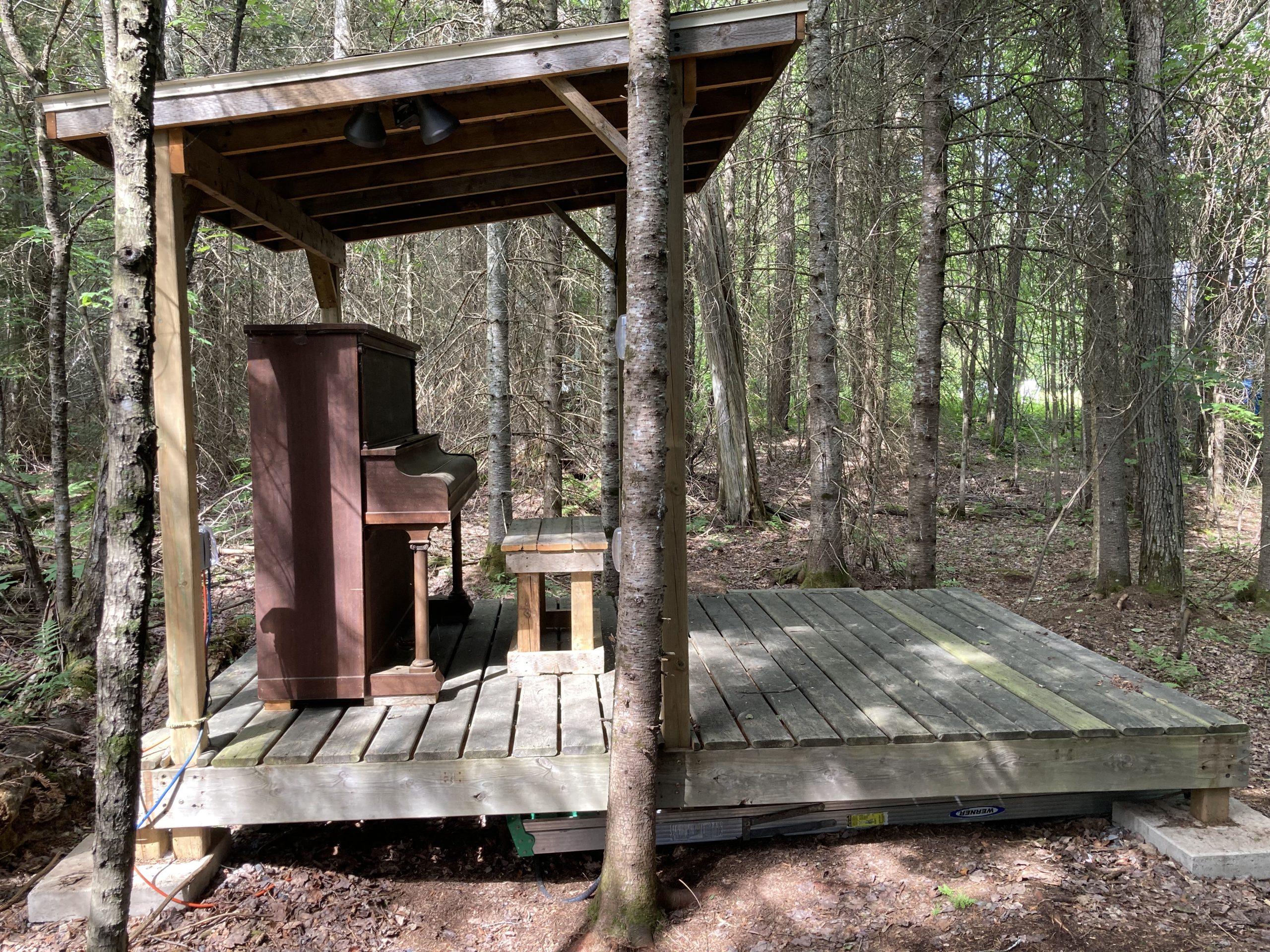
The recordings made for this series are all done one single outdoor location, which is The Weathered Pianos site at Warbler’s Roost. The piano is in a forest close to the home of the artist. It is bolted to a deck and covered by a shed roof.
The soundscape recorded is undoubtedly altered by the physical structure of the piano as well as the roof and deck. These structures absorb the elements as well as the activities of the animals and people around them. The internal resonances, the bending and flexing of the wood with shifts in temperature, all influence what is captured on the recordings.
The compositional approach with these pieces is to avoid the inclination to layer together recordings from different moments in time. Instead with these pieces one recording is selected and allowed to play out as long as the artist remains engaged in listening to it. The judgement of where to start and stop the edit of a recording is determined by striking a balance between the artist’s personal listening attention and instincts versus his interest in preserving the natural flow of events.
The recordings are done originally in 4-channel and later are mixed to stereo. There is a matched pair of condenser microphones fixed to the beams of the shed roof and another pair are inside the piano. All of the recordings on the album were made without the recordist present during the time of recording. If the artist is present at all, it is only has another being making sound in the soundscape.
Responding to Changing Weather

The transition from winter to spring often inspires lots of adaptive activity.
This 57-minute piece is taken from 48 hours of continuous soundscape recording made between March 22 and 24, 2025 at the Weathered Pianos site at Warbler’s Roost, 22 km west of South River, Ontario, Canada. Like other Absent Listener pieces, the recordist was not present at the recording site during the time of recording.
Technically late March is very early spring but the conditions at that time were still more winter-like. The temperature shifted from -2 Celsius down to -14 and then back up to 0. The lowest point in the temperature led to the popping of nearby trees and the piano, decking and roof structures. The snow from the previous day led to a pass from the snow plow, while the colder weather kept the ground hard, which allowed for the logging trucks to access the road before it would be closed for the spring thaw. The calmer periods provided an opportunity to prepare for that eventual thaw in other ways, as heard with the chainsaws in the distance and the drumming of Pileated Woodpeckers.
Squirrel Inside the Piano
The soundscape in this piece was recorded over a three hour period in the evening of June 17, 2025 – just at the end of the Spring season. My partner and I were driving home from an overnight trip. In fact, the arrival of our vehicle is included in the piece, and during our car trip we could see the rain approaching in the skies which is heard in the latter part of the piece.
Unknown to me at the time was that a red squirrel decided to investigate behind the lid of the piano. It triggered a few plucks of the strings in the process. Thankfully its interactions were recorded. When I listened afterwards to the recording of the squirrel’s interactions with the piano, I decided to go against the ethos of this project entirely. I extended that event through different parts of the piece by slowing it down and transforming it other ways too.
Notable Contrasts

The title “Notable Contrasts” refers to contrasting states of weather and the extreme range of distances from which sounds originated. These are particularly evident in the soundscape that unfolded over the 48 hour period between October 3 and 5, 2025 from which the recordings in this piece were selected. Like all other Absent Listener pieces the soundscape recordings were made without the recordist present at the location.
At the outset there is the crisp dry sound of the leaves as they are moving in the wind and crunching under the rapid darting of the Red Squirrels or the steps of the Roughed Grouse. The conditions were quite dry through the late part of the summer and the early part of autumn. That dryness suddenly becomes a memory with the rainfall in the last half hour of this sequence, which marks a definite change in the weather patterns that followed later in the autumn. The last half hour of the piece is dominated by the rain hitting the wooden shed roof that protects the outdoor piano (at Warbler’s Roost) where this recording is made.
Close and Far is the other notable contrast. Some sounds that are audible are kilometers away, while others like the resonant pops of the piano and wooden shelter, were transmitted through the structure on which the microphones were attached. This expansive range of loud and soft, and the chance to hear sounds from far away, is one of the features of the location that keep the artist interested in recording there.
Weathered Piano Location
To listen to the piano being played, here is an improvisation by my partner Nadene Thériault-Copeland. She recorded it in early April 2025. She called the piece Longing for Spring, as you can see winter coats are still needed in the early weeks of Spring. See her weatheredpianos project website for more background on her interest in Weathered Pianos.